The State of Entry-Level Cloud Hiring: September 2026
September 20, 2026
Of 3,887 active cloud job postings in September of 2026: only 1.7% are entry-level, almost half of them are internships, 3/4 are onsite, and disclosed entry salaries cluster around $95,000.
Last Updated: September 2026
I'm writing this piece after seeing post after post about how hard it is to find a first job, get one's foot in the door, etc. Quite frankly, they are right. Here is a direct link to entry-level jobs.
At time of writing, only 65 of 3,887 active cloud job listings (1.7%) are targeting junior candidates. Almost half are internships. I've put together some charts and analysis. For those new here, you can find my data methodology here; briefly: every day, new jobs are added and stale jobs are removed. The jobs are collected from three ATS systems and from jobs that employers post directly on this site. Jobs are collected without any keyword/industry filtering, the germane ones remain.
This analysis comes from the data currently on the job board. The data is derived from live listings tagged with technologies like AWS, Azure, GCP, and Kubernetes.
Only 1.7% of Cloud Listings Are Entry-Level
The headline is that the entry-level slice is tiny. 1.7% of active postings meet the entry-level criteria. The other 98.3% explicitly want mid-level or senior engineers.
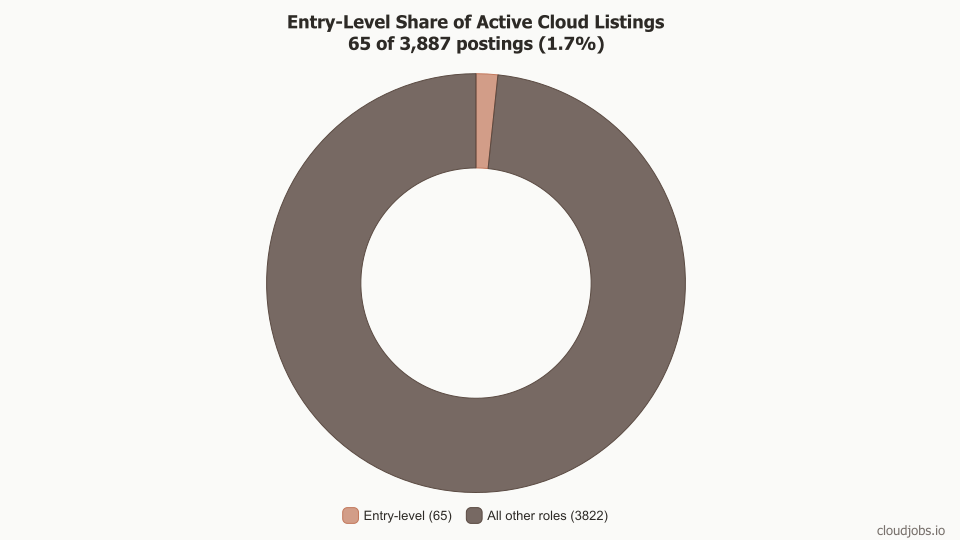 Entry-level postings make up less than 2% of the active cloud job market.
An unfortunate reality is that AI can spit out Terraform and CI/CD pipelines faster than humans can, and a senior engineer will get better results from an AI than a junior. If I were a human entry-level, I would think long and hard about what I can bring to the table that an agent can't. Find a way to be a cheap "senior engineer" rather than a mentee or long-term investment.
Nearly Half of Entry-Level Jobs Are Internships
It gets worse. 29 of 65 (~45%) of entry-level jobs are for interns. 19 are associates, 14 are juniors, and 8 are graduate programs. Of course, these are just titles, and titles don't always match reality; it is still a decent assumption that internships are summer programs and associate/junior roles are full-time roles. If you remove intern programs, under 1% of cloud jobs are entry-level.
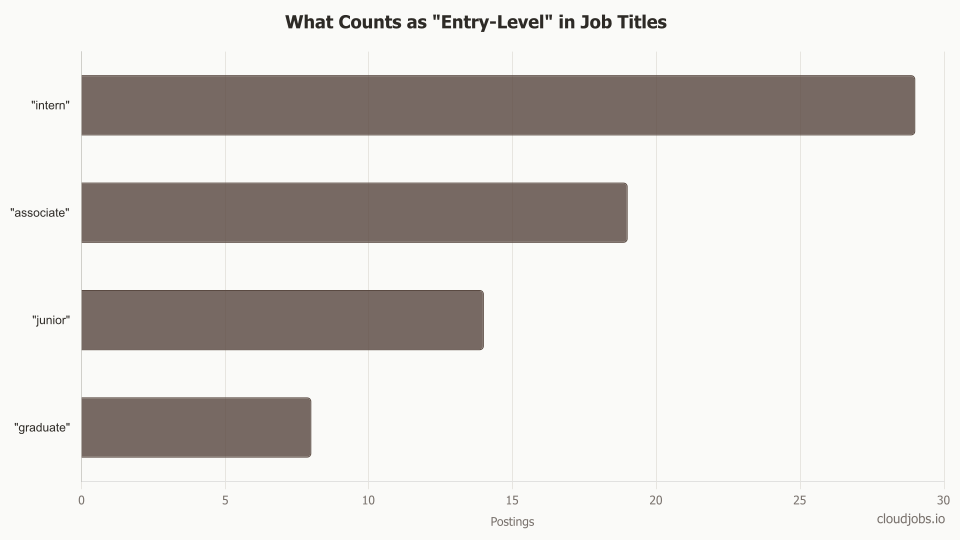 Most entry-level cloud hiring happens through internship and graduate programs, not junior titles.
One caveat is that it's September. Companies typically do the most intern hiring between August and November, so internships are heavily weighted right now.
If you're in college, put serious effort into finding an internship somewhere known for making return offers. A "Cloud Intern" role in a real engineering org is a much better stepping stone than the "Junior Engineer" job that requires two years of production experience with Kubernetes.
What Entry-Level Roles Actually Ask For
The technology mix in entry-level postings looks different from the overall cloud market. Programming fundamentals dominate:
- Python: 47 postings - the top requirement by a wide margin
- AWS: 38 - still the default cloud platform
- JavaScript: 26 and Azure: 25
- SQL: 22, Java: 17, Linux: 16
- Kubernetes: 15, GCP: 12
- Terraform: only 6
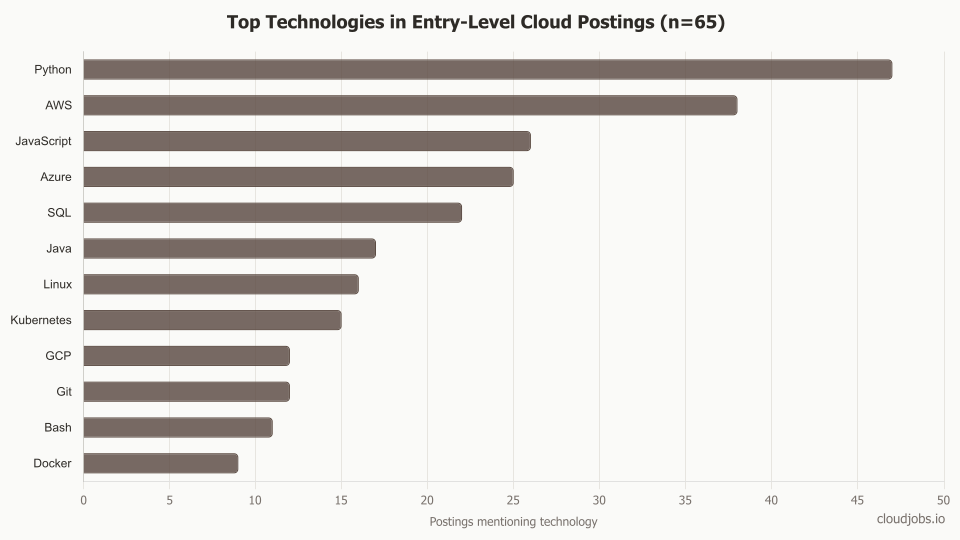 Entry-level postings ask for programming and platform basics, not the cloud-native stack.
It shouldn't be a surprise that Python is more requested than Azure or AWS, it's a scripting language without "competitors" and AWS/Azure can be mutually exclusive. Additionally, GCP is lacking. There are only 12 GCP jobs and each also mentions AWS and Azure. Lines like "Basic understanding of cloud platforms such as GCP, AWS, or Azure" are common.
If you're entry-level, learn Python, write it yourself instead of generating it with AI, and be ready to talk about your projects.
Entry-Level Postings Don't Usually Require Certifications
Most entry-level jobs don't ask for certifications. Across the 65 entry-level roles I analyzed, the most-mentioned certification is Security+, with just 3 mentions. CEH has 2, and CompTIA A+, CISSP, Network+, OSCP, and AZ-900 have 1 each (CEH is expensive and ambitious for an entry-level position, but it apparently helps you stand out).
This does not mean certifications are worthless. They help you pass HR screens, they provide a "curriculum" for learning useful information, and they can impress/reassure people in interviews. But hiring managers posting junior roles usually do not filter for them.
If you are going to certify for an entry-level path, Security+ is the one that shows up in actual postings, largely because federal and security-adjacent employers (like Accenture Federal Services, a top entry-level hirer in our data) require it. (Author's note: I got Security+ in college. I'm not sure if it helped me, but I've needed it for roles later on in my career.)
Entry-Level Jobs Are Less Remote
Juniors are on a tighter leash than seniors. 75% of entry-level cloud postings are onsite, vs. 64% of the overall market. 20% of entry-level roles are remote vs. 32% of all cloud jobs. The gap is made up of hybrid roles or roles without location info.
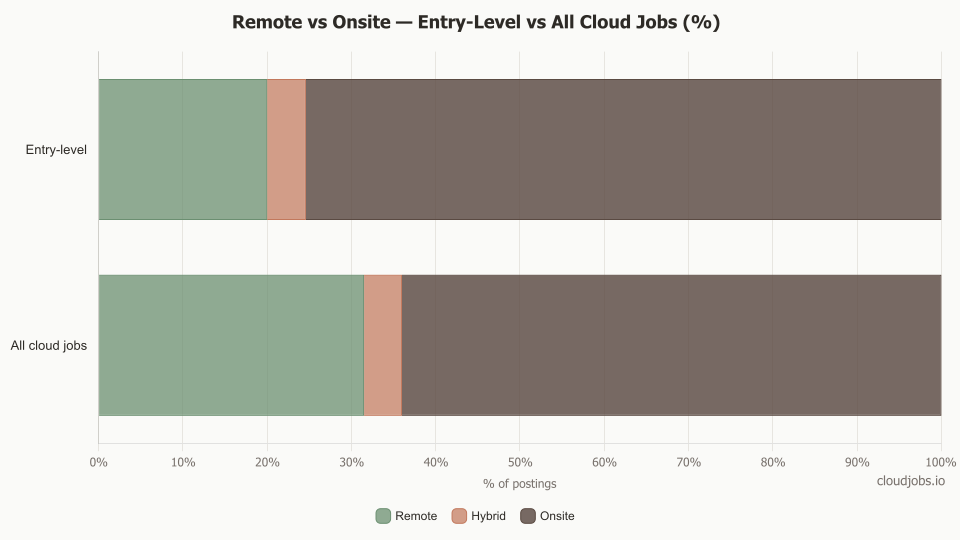 Companies are more willing to hire senior people remotely than junior people.
If you can relocate or commute for your first role, you triple the pool of listings available to you. That said, a lot of entry-level roles are listed as onsite or hybrid, but it has been the practice at every company I've worked for to give the juniors get 1-2 days remote once more trust is established.
What Entry-Level Cloud Jobs Pay
Only 22% of entry-level postings disclose salary (14 of 65), so treat these numbers as directional rather than precise. Among listings that do publish a range:
- Median disclosed salary: $95,000
- Middle 50% (interquartile range): $79,000 – $105,000
This is a small sample and pretty close to the median American income, but it's a good bit less than the average pay for the industry once you include mid-level and senior jobs. The averall cloud job median is $203,500 for comparison (from 1,983 postings with disclosed pay).
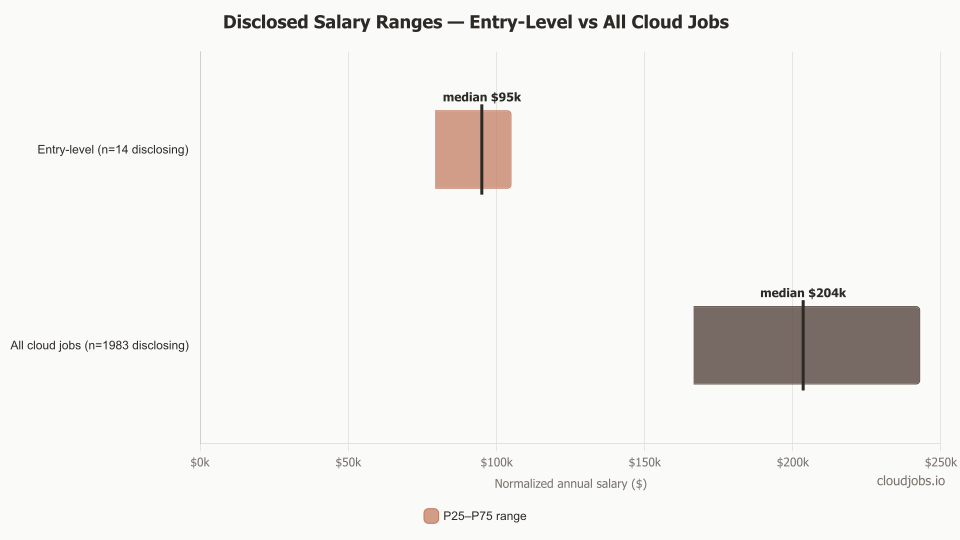 Entry-level postings that disclose pay cluster around $79k–$105k. The overall market median is far higher, and it skews senior.
The gap is real: the jump from a $95k junior role to a $150k+ mid-level role happens fast, usually within two to four years (unfortunately, usually only when you change jobs), and it's part of why the entry-level grind is worth pushing through. For more on the other end of the range, see our breakdown of the highest-paying cloud skills.
Which Companies Hire Entry-Level Engineers
These are the companies with the most entry-level cloud postings at time of writing:
| Company | Entry-Level Postings |
|---|---|
| AvePoint | 7 |
| Canonical | 5 |
| Figma | 3 |
| Robinhood | 3 |
| Palantir | 3 |
| Snowflake | 3 |
| MongoDB | 2 |
| Appian | 2 |
| Charles River Associates | 2 |
| Zip | 2 |
The pattern: huge companies with mature engineering orgs and government contractors with clearance-driven pipelines (Accenture Federal Services). Some places like Accenture hire "entry-level" engineers out of the military; they have security clearances and years of experience but no private sector experience.
Conclusion
Only 1.7% of job postings are entry-level. Many of them are internships. They skew onsite. The middle 50% of them pay between $79k and $105k.
Companies want to see fundamentals like Python and SQL, Linux, and some experience with at least one cloud platform. Flashier techs like the Kubernetes, Terraform, and ELK Stack are valued in senior roles, but they're the type of thing you can learn on the job. If you have a long list of technologies like Outlook and Excel, you might be wasting space.